
How to Tell if You Have Diastasis Recti

If you're like most people, you've probably heard of diastasis recti and are wondering whether or not you have it.
In order to better understand diastasis recti, let’s talk about the core first.
The core is made up of a group of muscles in your abdomen that gives you support and stability.
Think of your core like your foundation.
Those muscles include your diaphragm, pelvic floor, four layers of abdominal muscles (the abdominal wall), and your lumbar muscles.
Your abdominal muscles include: the transverse abdominis, internal obliques, external obliques, and the rectus abdominis. The rectus abdominis is your “six pack” muscle and the fibers run vertically.
See the image below:
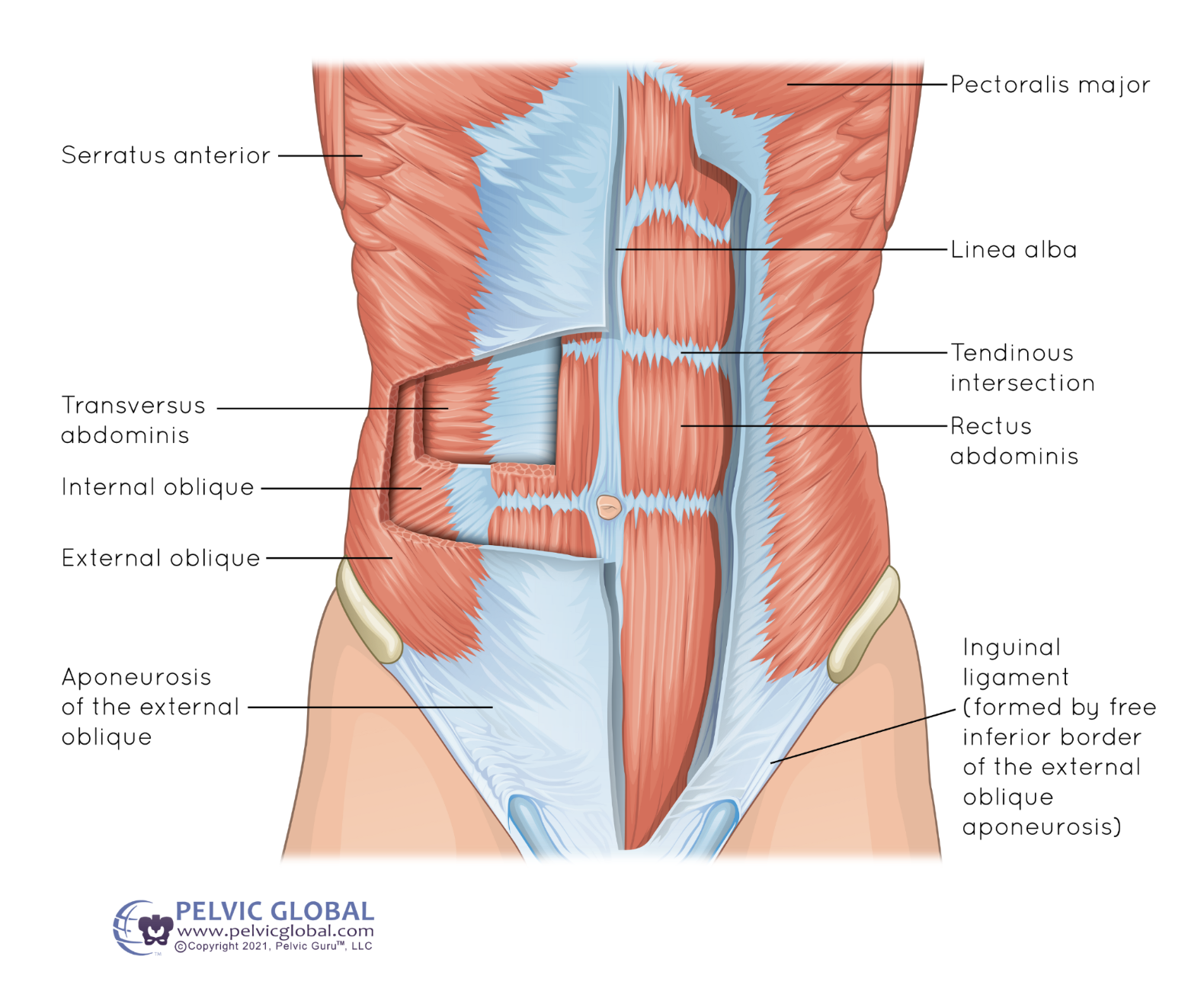
Used with permission from Pelvic Global, LLC
What Is Diastasis Recti
Diastasis recti is when the right and left sides of your rectus abdominis spread apart. This occurs due to the lengthening of the tissue called the linea alba, the dense fascia that holds the two sides of your rectus abdominis together.
What Causes It
The most common cause of diastasis recti is pregnancy, and it is supposed to occur during pregnancy! As your uterus expands and your belly grows, the diastasis happens to create room for your baby to grow!
Once the baby is delivered, the linea alba is no longer being stressed and lengthened by a growing baby so the tissue begins to heal and shorten back together.
Diastasis can also happen due to increased straining during lifting which can stress the linea alba over time.
But don’t confuse this with a hernia. With diastasis, there is no organ pushing through the linea alba. Where as with a hernia, there is an organ that is pressing through that space.
When there is increased pressure or stress on the abdomen that continues after birth or a straining injury, the diastasis may not be able to heal on its own without addressing the pressure problem.
Who Is Most Likely to Get Diastasis Recti
As I mentioned before, diastasis recti occurs during pregnancy. But it can also happen due to increased stress on the core including lifting or increased weight gain.
It is the result of pressure on the muscles during activity. Over time, the pressure exceeds the muscles’ ability to handle it. When that happens, a diastasis can be a result. It really is all about pressure management within the core.
Signs and Symptoms to Look For
Diastasis recti can cause pain and/or pressure around the stomach.
You may also notice a bulge at the center of your abdomen, especially when you strain or use your core.
Most people I work with who arrive worried about whether or not they have a diastasis will say that their core feels like there is a hole in it, like it is empty. They feel weak, or they can actually see a bulge or large divot where their abdominal muscles are.
How to Self-Check for Diastasis at Home
You can perform a self assessment for diastasis at home by lying down flat so that you are in a relaxed position.
Feel around your belly button and down the center line of your stomach for any indentation or gapping.
Then, lift your head up off the floor while you keep your hands where they are. Feel whether or not there is a change in that indentation or gap as you lift your head off up off the surface you are lying on.
By lifting your head you create more pressure at your abdomen making the linea alba separation more obvious.
The diastasis can be measured by depth and gap using finger measurements, but that method is not very objective because everyone's fingers are different sized, so don’t get hung up on that!
What a Physical Therapist Looks For
A physical therapist will do an assessment like the one explained above. But more importantly, the PT will be interested in how your core is functioning.
Physical therapy assessment and treatment will start by checking breathing mechanics at rest.
We will also review pressure control during activity.
Then we will progress to strategies that improve pressure control inside the core during activity.
Is Diastasis Recti Causing Your Core Problems?
so you might be wondering whether or not diastasis recti is causing the core issues that you are experiencing, whether that is weakness, bulging, pain, or something else.
This is a tough question to answer, because diastasis recti can cause core problems, and poor core mechanics can cause diastasis recti.
So it's like a chicken or egg question… Good thing we don’t need the answer to treat the problem!=
Either way, conservative treatment will be the same!
What to Do If You Think You Have It
If you are struggling with diastasis recti, I recommend reaching out to a pelvic floor physical therapist. Because of the core’s connection to the pelvic floor, a pelvic floor PT will be able to assess any other connections of the pelvis to the diastasis recti.
Working with a PT you will learn how to pressurize the core through proper breathing mechanics. Breathing is totally connected to core stability because of the diaphragm's connection to the core. Pressurization creates stability.
In order to keep the core pressurized, the core muscles need to coordinate inhaling and exhaling together.
Once you master this breathing technique, you will progress to higher level core training while maintaining the breathing technique.
Where to Find Diastasis Treatment in the Lakes Region of New Hampshire
If you are local to the Lakes Region of New Hampshire and are interested in working together to address your diastasis recti, book a discovery call or eval to get started with treatment today!
My office is conveniently located in Meredith, NH and I offer pelvic floor therapy with a focus on active individuals. I’d love to work with you.